
ASTANA – On Sept. 12, Kazakhstan’s Elena Rybakina defeated Aryna Sabalenka 6-4, 5-7, 6-2 in the US Open final to claim the third Grand Slam title of her career.
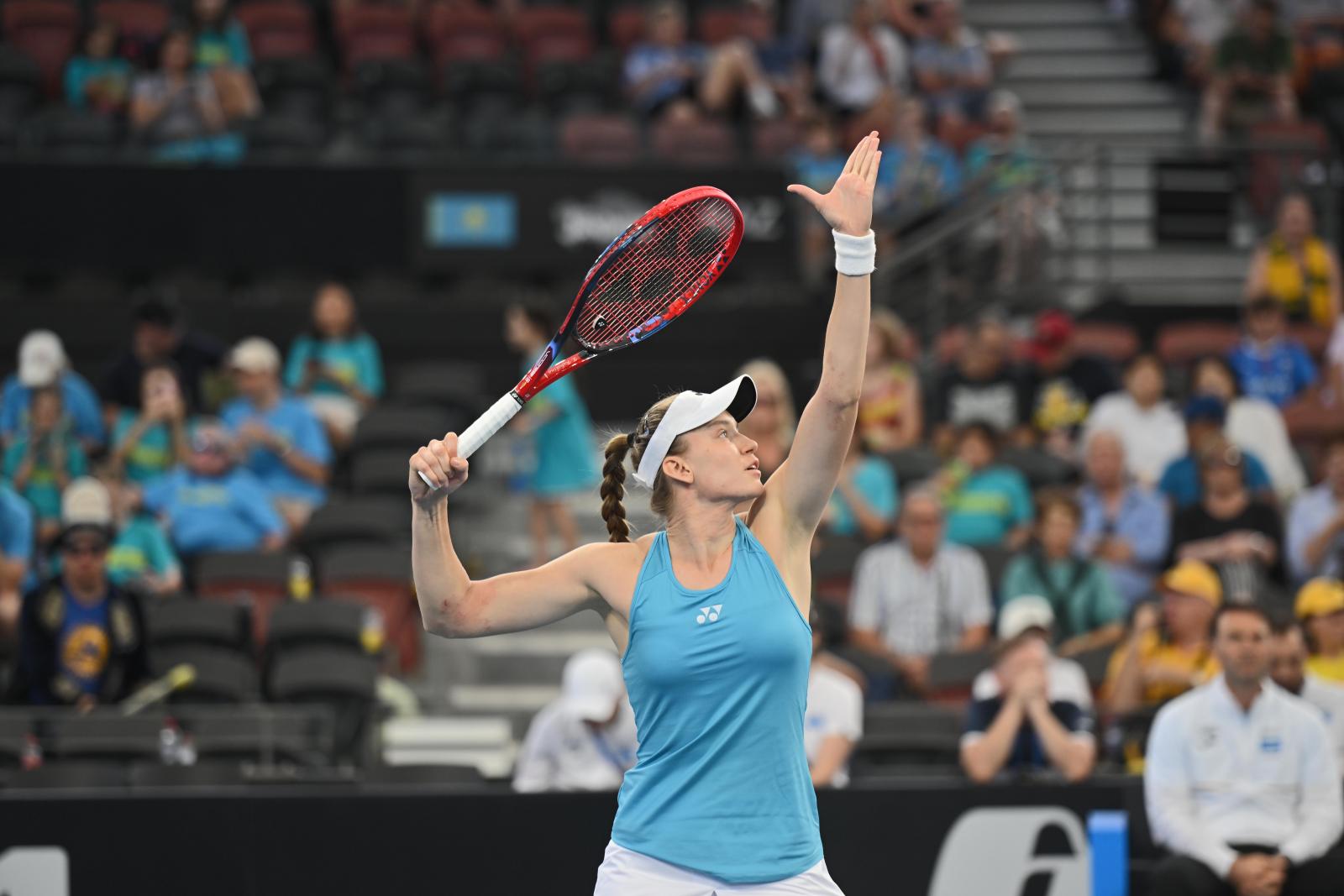
Photo credit: ktf
The victory ended Sabalenka’s 19-match winning streak at the tournament and completed a remarkable rise for Rybakina. A few days before that, she became the world No. 1, the 30th woman in WTA history to reach the top of the rankings and the first player representing Kazakhstan to do so.
Rybakina had technically secured the No. 1 ranking before the final, after defeating Zheng Qinwen in the quarterfinals. But winning the title made the achievement even more significant.
It was also an unexpected conclusion to a tournament that had begun with uncertainty. Rybakina arrived in New York after spending a week away from the court because of a left-foot injury. She had retired during the first set of her Cincinnati match against Iga Swiatek, and that tournament could have given her an earlier opportunity to reach the top of the rankings.
Instead, she reached No. 1 in New York.
“I don’t want to put too much pressure on myself,” Rybakina said before the final, explaining that regardless of the result, she would still have other opportunities ahead.
The Grand Slam
Before 2026, the US Open was Rybakina’s least successful Grand Slam tournament.
Across eight previous appearances, she had never advanced beyond the fourth round. This time, however, she defeated Thea Frodin, Jessica Bouzas Maneiro and Yuliia Starodubtseva before overcoming former champion Naomi Osaka.
Photo credit: ktf
Her quarterfinal against Zheng Qinwen became another test of her ability to recover. Rybakina lost the opening set but fought back to win the match.
The semifinal against Coco Gauff followed a similar pattern. After losing the first set 3-6, Rybakina won the next two 6-4, 6-4 to reach her first US Open final.
Three consecutive comeback victories were significant for a player whose game has often been associated with a straightforward formula: a powerful serve, flat groundstrokes and an aggressive style of play.
In New York, she demonstrated another side of her game: the ability to adapt, recover and win when a match does not follow her preferred script.
A tennis player almost by accident
Rybakina was born in Moscow on June 17, 1999. She initially tried several sports with her elder sister Anna, including gymnastics and figure skating. Tennis came later.
Because of her height, gymnastics and figure skating eventually became less suitable, and her father, who was interested in tennis, suggested that she try the sport. She was six years old.
Rybakina trained first at Dynamo and later at Spartak, where she worked with former Top-10 player Andrei Chesnokov and former world No. 100 Evgenia Kulikovskaya.
For years, she did not have an individual coach. Until the age of 15, she trained in a group of around eight players and later in a smaller group of four.
Her daily schedule also looked different from that of many young elite athletes. She spent roughly two hours on tennis and another three hours on physical preparation while attending a regular school rather than a specialized sports school.
This became an important part of her development. Rybakina was not raised through one of the highly structured tennis academies that produce professional players from an early age. Much of the work that would eventually turn her into an elite athlete came later.
From junior success to an uncertain future
Rybakina entered the ITF junior circuit in November 2013, at the age of 14.
Her strongest junior season came in 2017. By the end of that season, she was ranked No. 3 in the world among juniors. But her path was not always smooth.
At the 2016 US Open junior tournament, Rybakina fainted because of low hemoglobin and withdrew in the first round. According to her account, her family did not receive sufficient assistance from representatives of the Russian Tennis Federation at the tournament.
After the incident, her parents decided that she would no longer travel to tournaments without them.
That created another problem: the cost.
Professional tennis requires constant travel, accommodation, coaching and tournament expenses. Her family could not indefinitely finance that lifestyle on its own.
As a result, Rybakina and her family seriously considered another route of moving to the United States or Canada, studying at a university and playing college tennis.
For a teenager who would eventually become world No. 1, a professional tennis career was still far from guaranteed.
The decision that changed her career
In 2018, shortly before turning 19, Rybakina received Kazakh citizenship and switched her sporting representation from Russia to Kazakhstan.
The initiative came from her father, Andrey Rybakin, who was born in Almaty. He contacted the Kazakhstan Tennis Federation, which offered financial support in exchange for her representing Kazakhstan.
Rybakina chose that opportunity instead of pursuing university tennis in the U.S.
The change affected her career in practical ways. The support allowed her to travel to tournaments, build a professional team and most importantly, work with a full-time coach who could accompany her on the tour.
In February 2019, Croatian coach Stefano Vukov became her coach. He was the first coach in her career to regularly travel with her to tournaments.
Rybakina later described Kazakhstan’s support as crucial.
“They believed in me,” she said in an interview with the WTA. “I was not so good when they offered. So they believed in me and they’re helping me a lot.”
The decision therefore meant more than simply changing the flag next to her name in the rankings. It came at a moment when Rybakina had to decide whether tennis would remain an after-school activity or become her profession. With Kazakhstan’s support, she chose the latter.
The first signs of a breakthrough
Rybakina’s first major breakthrough on the WTA Tour came in St. Petersburg in 2018.
After winning her first WTA-level match, she moved up from around No. 450 to No. 268. The following year brought an even bigger step. In July 2019, Rybakina won her first WTA title in Bucharest, which pushed her into the Top 100 for the first time, at No. 65. She ended the season ranked No. 37.
Then came 2020. Rybakina reached five finals during the season, more than any other women’s player that year, and won the title in Hobart. By the time the COVID-19 pandemic interrupted the tennis season, Rybakina had risen to No. 17 and become the first Kazakh player to enter the WTA Top 20.
In 2021, she reached her first Grand Slam quarterfinal at Roland Garros, defeating Serena Williams on the way, and finished fourth at the Tokyo Olympics.
Rybakina was no longer simply a promising young player. She was becoming one of the strongest players on tour.
Wimbledon 2022: the title that changed everything
The biggest moment of her career came at Wimbledon in 2022. At 23, Rybakina became the first player representing Kazakhstan to win a Grand Slam singles title.
The victory also created a complicated situation because Wimbledon had banned Russian and Belarusian players following Russia’s invasion of Ukraine. Rybakina had been born in Moscow and had represented Russia as a junior, leading to considerable discussion around her nationality and sporting identity.
There was another unusual consequence: Wimbledon did not award ranking points that year. As a result, winning the tournament did not improve Rybakina’s ranking in the way a Grand Slam victory normally would.
She ended 2022 ranked No. 22 and did not qualify for the WTA Finals.
From Grand Slam champion to a Top-3 player
The next major step came in 2023. Rybakina reached the Australian Open final and then won two WTA 1000 titles, in Indian Wells and Rome. In June, she reached a career-high No. 3 in the WTA rankings.
But the following two years were less straightforward. Injuries and health problems affected her schedule, while changes to her coaching team added another layer of uncertainty.
She split with Vukov after the 2024 US Open and briefly worked with former Wimbledon champion Goran Ivanisevic. She later reunited with Vukov, who was subsequently suspended by the WTA for 12 months. Rybakina also worked with Davide Sanguinetti during this period.
While she had fallen to No. 11 in April 2025, the year of 2025 became another turning point.
At the 2025 WTA Finals in Riyadh, Rybakina entered the tournament as the final qualifier among the eight players. She then won the entire tournament without losing a match. The victory brought her back into the world’s Top 5 and gave her the biggest title of her career since Wimbledon.
2026: the season that took her to the top
Rybakina began 2026 by winning the Australian Open. Rybakina won 6-4, 4-6, 6-4 in a match against Sabalenka to claim her second Grand Slam title.
She later won in Stuttgart and reached the finals in Indian Wells and Toronto.
When she arrived in New York, she was ranked No. 2. The gap between Rybakina and Sabalenka at the top of the rankings had become one of the central storylines of the season.
Rybakina secured the No. 1 ranking after defeating Zheng Qinwen in the quarterfinals. But she still had two matches to play.
“You never know how long you’re going to stay. I want to win the titles still in tournaments, so all my thoughts are just for the next match,” she said.
That mentality carried her through the semifinal against Gauff and into the final against Sabalenka.
Rybakina’s victory over Sabalenka in the US Open final completed perhaps the most successful season of her career.
She became a three-time Grand Slam champion, won her first US Open and became the first world No. 1 in the history of Kazakh tennis.
Rybakina said she would like to win the French Open one day and complete a career Grand Slam. The achievement matters, she said, but she does not want to spend too much time thinking about it. There will always be another tournament, another opponent and another problem to solve.
That perspective is consistent with the story of her career.
Rybakina was not a child prodigy who was destined for the top from the beginning. She started tennis because other sports were not a good fit. She trained without an individual coach for years. At 17, she was still considering university instead of professional tennis.
Her career changed when Kazakhstan offered her the support needed to make professional tennis financially and logistically possible. From there, the progress came step by step and the ranking is only one part of the story. The girl who once played tennis simply because it was something to do after school had become the best-ranked women’s player in the world.
And, for Rybakina, there was still another match ahead.
