
NEW DELHI – Beyond the official agenda and meetings of the 18th BRICS Summit in New Delhi, a special exhibition showcasing the cultures of the grouping’s member and partner countries will run Sept. 10-15, highlighting the bloc’s cultural diversity.
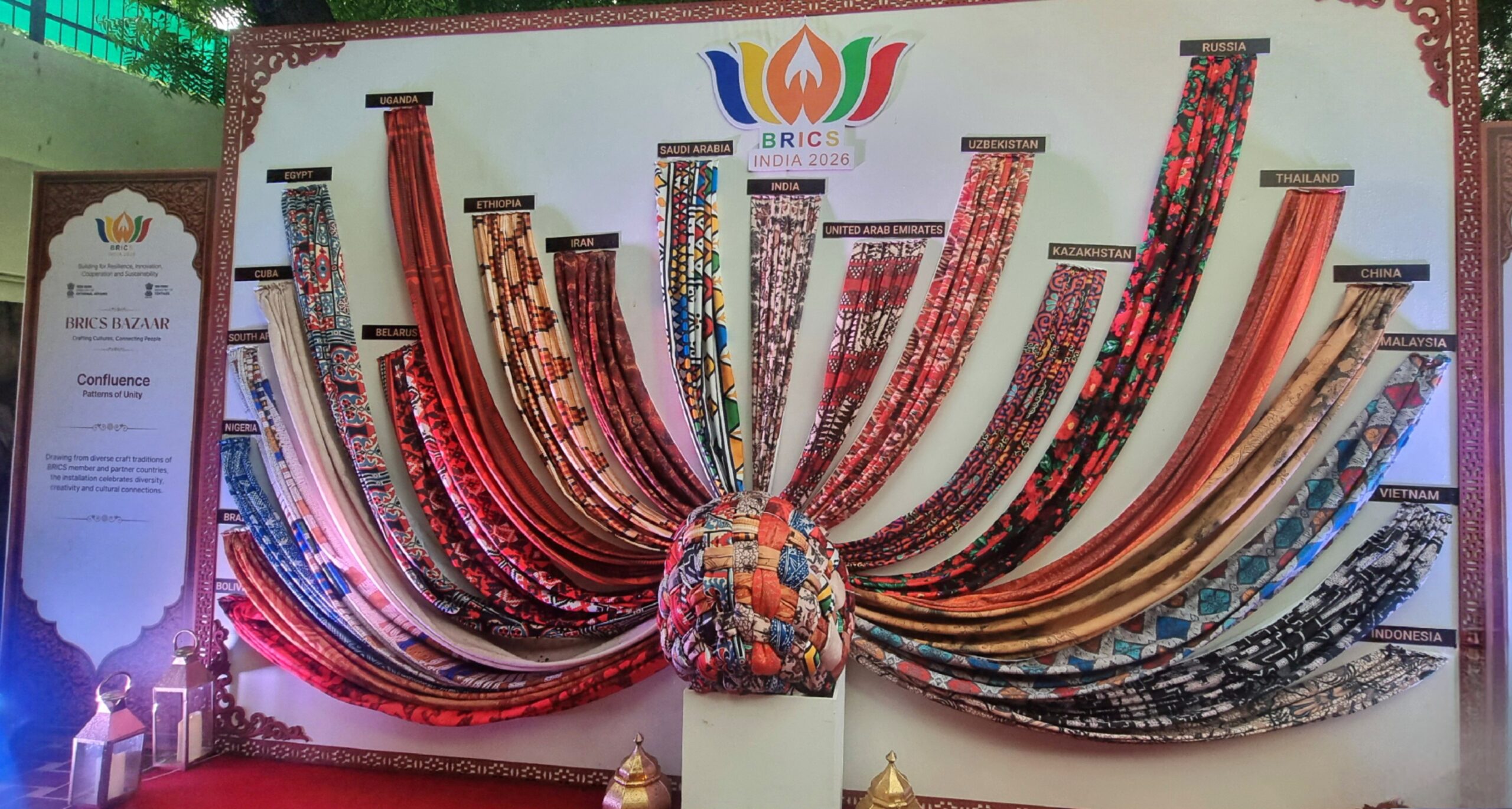
Confluence: Patterns of Unity a colorful installation at the BRICS bazaar. Photo credit: The Astana Times
The bazaar brings together artisans, designers and companies from participating countries. The venue offers visitors an opportunity to explore authentic handicrafts, textiles, works of art and other cultural products. The program also features master classes and performances highlighting the artistic traditions of the participating countries.
The event provides a platform for cultural exchange and artistic appreciation while fostering friendship and cooperation among participating countries. It also brings India’s diverse handicraft traditions to an international audience.
At the bazaar’s entrance, visitors are greeted by a colorful installation titled Confluence: Patterns of Unity. At its center is a woven sphere from which strips of traditional textiles fan outward like a tree’s branches or the sun’s rays. Each strip represents a participating country and features distinctive colors, patterns, and weaving traditions.
Dr. Sameer Sood, director of the National Institute of Fashion Technology, who conceived the installation, said its purpose was to demonstrate that various cultures share common values and traditions.
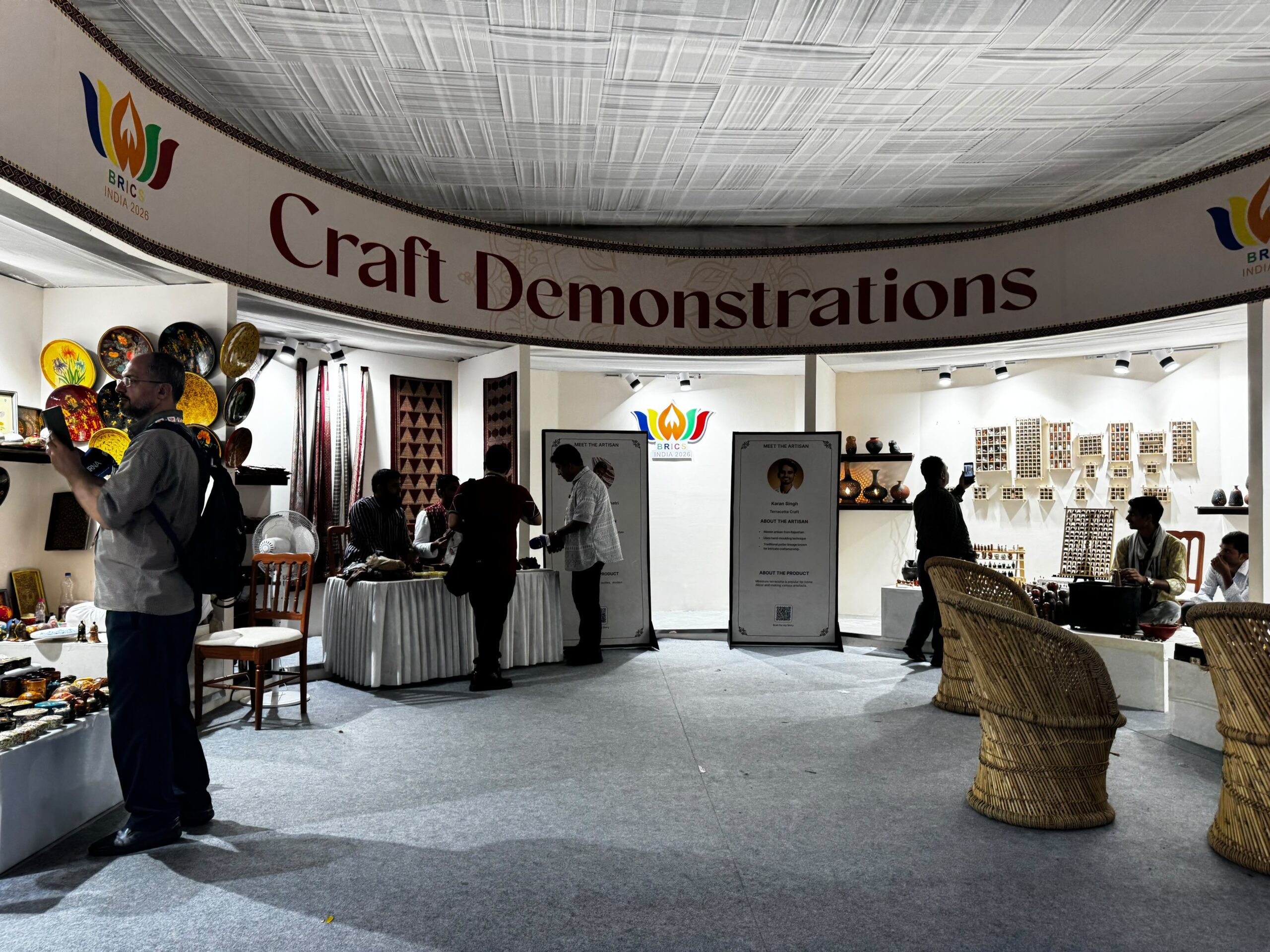
Photo credit: The Astana Times
“We drew on the craft traditions of these countries and the broader themes of resilience, cooperation and sustainability. We wanted to show that these crafts reflect the spirit of cooperation and are rooted in sustainable practices,” Sood told The Astana Times.
The design representing Kazakhstan was inspired by tuskiiz, a traditional handmade wall panel created using embroidery on felt, velvet or fabric.
Sood noted that similar craft traditions can be found in India, highlighting the cultural connections between the two countries.
“Political boundaries of the nations came into the picture only thousands of years ago. Before that, all the nations were basically one. We also wanted to convey the message of ‘one world, one family, one future,’” Sood said.
“It is also one of the messages that all the crafts are very similar and all the countries have a togetherness aspect,” he added.
Kazakhstan’s craft traditions
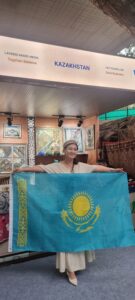
Kazakh artisan Togzhan Babiyeva from Uralsk represents Kazakhstan at the bazaar. Photo credit: The Astana Times
Kazakh artisan Togzhan Babiyeva from Uralsk represents Kazakhstan at the bazaar.
Speaking to The Astana Times, Babiyeva said it was her first time participating in an international event of this scale as part of an official delegation.
Babiyeva runs a small workshop in Uralsk, where she combines traditional and contemporary techniques.
“I work with a variety of materials, including leather, wood, felt, acrylics and canvas. I use various techniques and am constantly experimenting. We combine traditional techniques with modern ones, creating a mix of both,” she said.
Her works are distinctive, with each piece carrying its own symbolism and meaning rooted in Kazakh culture.
“Each painting has its own meaning, because every ornament in our Kazakh culture speaks, and speaks in symbols,” Babiyeva said.
One of her works features a tumar, a traditional Kazakh talisman. Babiyeva said the particular design represents a woman and her role in family life.
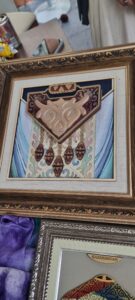
The work features a tumar, a traditional Kazakh talisman. Photo credit: The Astana Times
“This is specifically a woman’s tumar. It’s like a cup, because a woman herself is like a cup. What you pour into it, she transmits to the world. If you give her something small, she praises it as big. If you give her an affectionate word, she will tell it with such dedication. If you give her some meat, she’ll make beshbarmak,” she said.
At the center of the painting are ornamental shapes resembling an angel and a pregnant woman with a baby, reflecting themes of family and motherhood.
Another work was created specifically with India in mind. Titled “The Power of the Earth,” it depicts a bull standing on a rock.
“As you know, cows and bulls hold a sacred place in Indian culture. In this painting, the bull represents the strength and power of the earth, while the bird symbolizes the opposite qualities such as lightness, happiness and the fleeting nature of dreams. I also depicted a mountain, incorporating petroglyphs as a reference to Kazakhstan,” Babiyeva said.
She also presented a work featuring a traditional Kazakh yurt, the dwelling of nomadic communities. She noted the painting focuses on the bosaga, the area around the entrance and threshold of the yurt.
“If this part is weakened, the whole structure will fall apart. Similarly, if there is no unity in the family, then it will all fall apart. So there is an analogy,” she said.
Kashmir’s papier-mâché heritage
Riyaz Ahmad, a master artisan of Kashmiri papier-mâché, is presenting another centuries-old craft tradition at the bazaar.
The craft involves transforming soaked waste paper into lightweight decorative objects, which are then painted with intricate floral motifs using fine brushes and, in some cases, gold. The technique is valued for both its artistic qualities and its use of recycled materials.
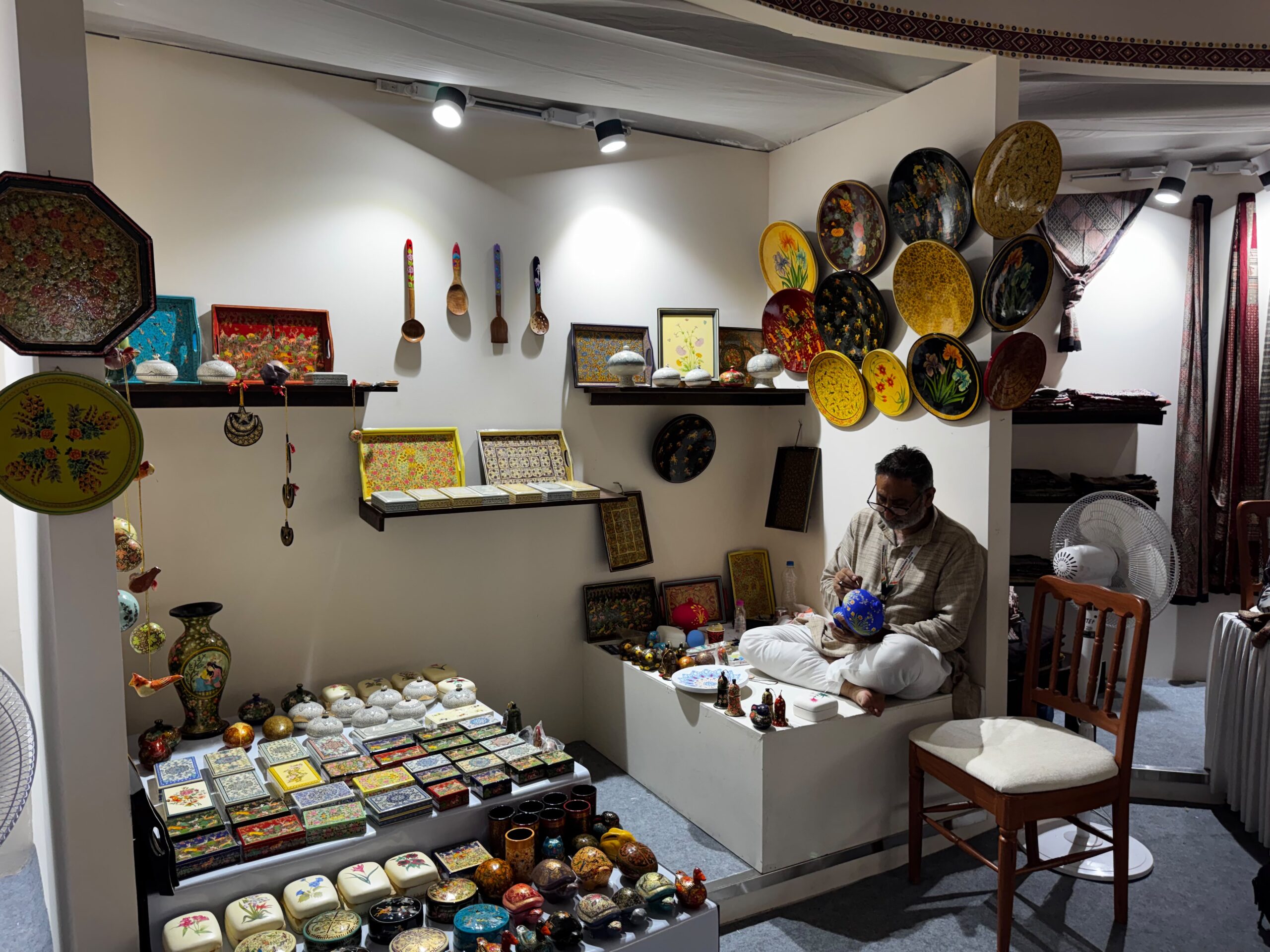
Riyaz Ahmad, a master artisan of Kashmiri papier-mâché. Photo credit: The Astana Times
Kashmiri papier-mâché is an established craft tradition dating back to the 14th century, when artisans from Central Asia and Iran helped introduce and develop the technique in Kashmir.
Today, artisans in Srinagar city continue to transform paper pulp into decorative objects featuring intricate floral and Mughal-inspired designs.
Ahmad’s collection includes handcrafted Kashmiri papier-mâché bowls, boxes, vases, wall hangings and decorative pieces adorned with floral, paisley, carpet and other traditional Kashmiri motifs.
Chinese bamboo craft
China’s traditional craft heritage is also represented at the bazaar by Yang Longmei, a provincial representative and inheritor of Daoming Bamboo Weaving.
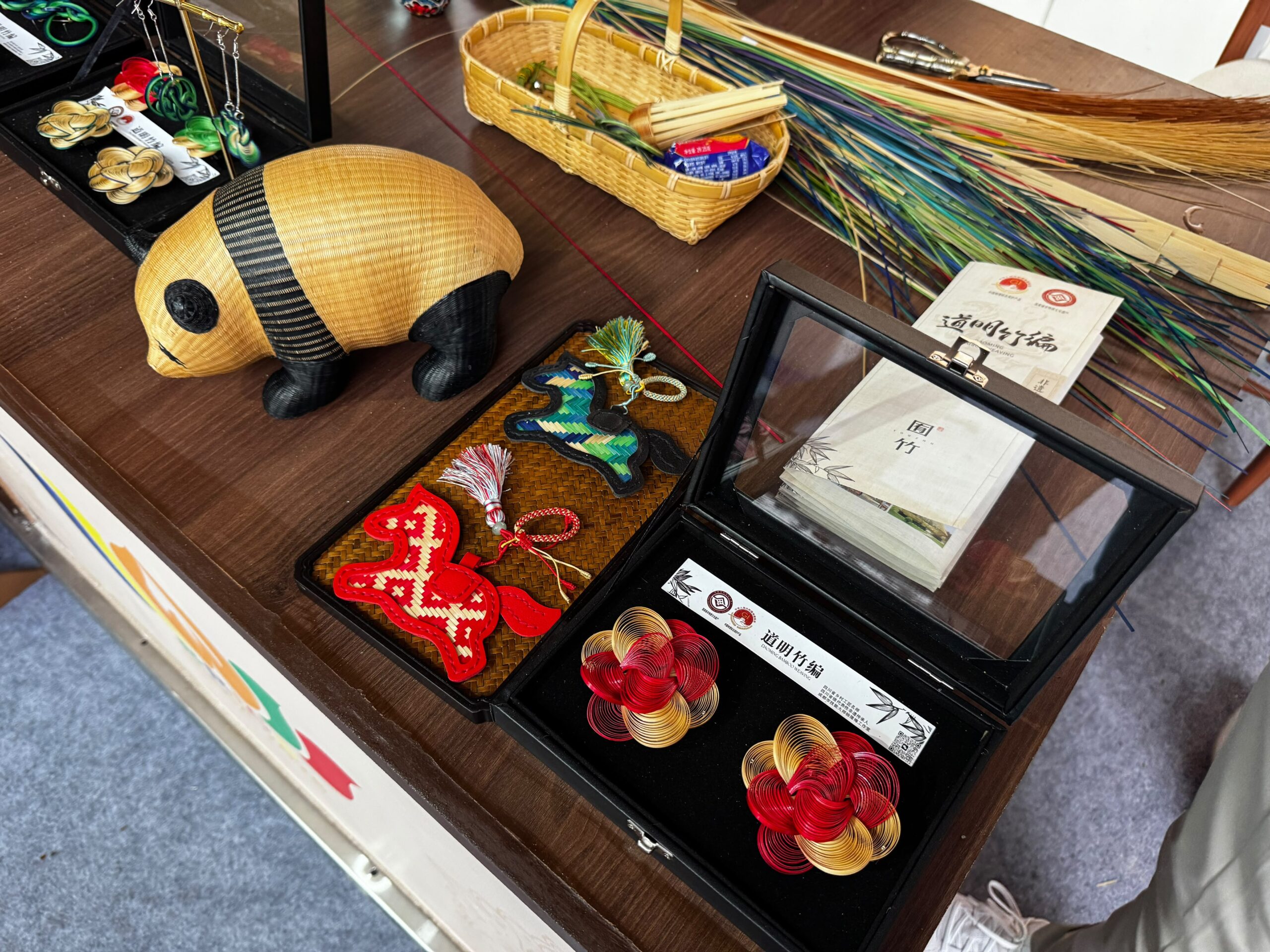
Works by Yang Longmei featuring traditional Chinese bamboo weaving. Photo credit: The Astana Times
She showcases the aesthetics and craftsmanship of traditional Chinese bamboo weaving while incorporating modern design and techniques.
Speaking to The Astana Times, she said bamboo weaving is a thousand-year-old Chinese intangible cultural heritage tradition. By combining traditional techniques with contemporary aesthetics, artisans transform raw bamboo into durable, artistic and functional objects.
Her collection included cultural and creative jewelry, modern home décor and custom-made high-end bamboo products.
