
TASHKENT – Digital and financial connectivity could become the next frontier of regional integration in Central Asia, as Uzbekistan seeks to accelerate its fintech development and advance greater connectivity within the region’s markets.
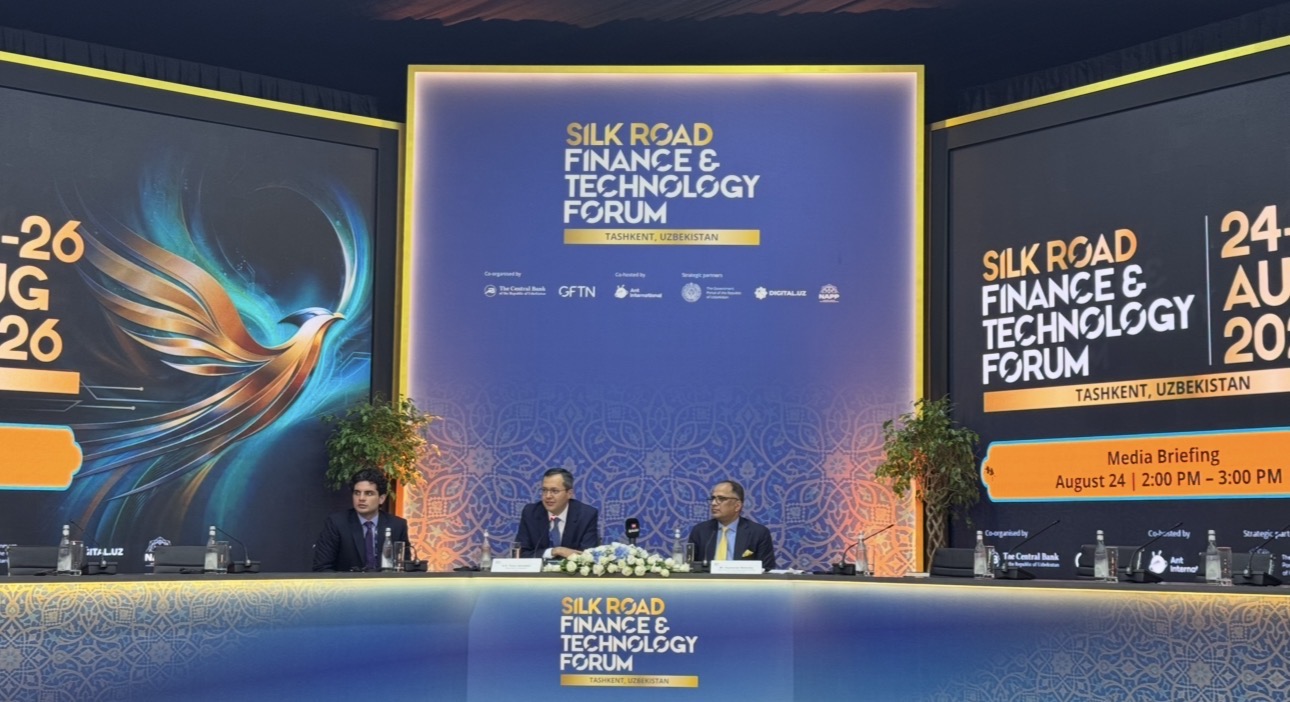
Central Bank of Uzbekistan Governor Timur Ishmetov (M) during the media briefing as part of the forum in Tashkent on Aug. 24. Photo credit: The Astana Times.
Central Bank of Uzbekistan Governor Timur Ishmetov called on global investors and innovators to work on infrastructure and standards that can connect markets across Central Asia and beyond.
“Regional financial connectivity cannot be built by one country alone. Build here. Test new solutions here. Invest here. Develop talent here. With the right partnerships, Central Asia can become a more connected, competitive and internationally integrated financial region,” said Ishmetov at the opening of the Silk Road Finance and Technology Forum 2026 on Aug. 24.
The initiative comes as Central Asia, a region of more than 80 million people, has been pursuing stronger economic cooperation while accelerating digital adoption and developing new channels for financial services.
Despite its demographic and economic potential, Central Asia’s share of global fintech investment remains “modest.” According to Ishmetov, in 2025, total venture capital funding across Central Asia amounted to approximately $320 million.
“This demonstrates the scale of the opportunity to convert the region’s young population, growing digital adoption, and developing financial infrastructure into sustainable investment and innovation,” he said.
For Ishmetov, the challenge is not simply to expand fintech within national markets but to create conditions for markets to connect with one another. Regional connectivity is seen as a key element of a sustainable fintech ecosystem along with regulation, infrastructure and investment.
“Efficient regional corridors are of utmost economic importance. There remains potential to strengthen payment connectivity between countries of our region and to expand the range of financial services available across borders. Digital finance changes the economic geography. Physical distance becomes substantially less restrictive and that is a strategic opportunity for our region,” he explained.
The economic foundation for connectivity has also been expanding. The report prepared by the Astana International Financial Centre (AIFC), in collaboration with the Institute for Advanced International Studies (IAIS) of Uzbekistan, highlighted the shift of the region from a peripheral destination into one of Eurasia’s more dynamic economic nodes over the past two decades.
Between 2000 and 2024, the countries of Central Asia significantly increased their accumulated stock of foreign direct investment. The UN Trade and Development (UNCTAD) World Investment Report 2025 indicated that the region’s total inward FDI stock reached $220.5 billion as of 2024.
The growing scale of investment and cross border activity brings a broader question for the region whether financial infrastructure can keep pace with the movement of goods, capital and businesses across connected markets.
Otabek Nasirov, chairman of Central Asian Fintech Association, said the region can and should move toward common standards for digital identity, payments and open banking.
“We do not necessarily need identical regulations in all five countries. What we need is interoperability: compatible digital identity frameworks, common principles for secure data exchange and consent, interoperable payment infrastructure, and APIs that allow financial institutions and fintech companies to work across borders,” Nasirov told The Astana Times.
Central Asian countries are developing their digital financial ecosystems at different speeds. The next challenge is to connect these national ecosystems.
“If we can make digital identity, payments and financial data work across borders, a fintech company should eventually be able to scale across Central Asia much more easily – reaching a regional market of more than 80 million people rather than treating each country as a completely separate market,” Nasirov said.
This will require close cooperation between central banks, governments, financial institutions, fintech companies and industry associations.
“I believe we should start with practical areas where interoperability can deliver immediate value cross-border payments and QR interoperability, digital KYC [Know Your Customer] and identity verification, and common approaches to Open Banking and consent-based data sharing,” he said.
“The goal should not be to create one regulator or one system for Central Asia, but to build a connected regional digital financial infrastructure based on mutually recognised standards. That could become one of the strongest drivers of fintech growth, investment and regional economic integration in Central Asia,” he said.
Tashkent is hosting the Silk Road Finance and Technology Forum 2026. The event is supported by the Central Bank of Uzbekistan and Singapore-headquartered Global Finance and Technology Network (GFTN), and co-hosted by Ant International on Aug. 24-26.
The event connects more than 6,000 participants from 74 countries in Tashkent. The forum focused on five key themes including digital payments and infrastructure, Islamic finance and new economic corridors, AI and emerging technologies, tokenization and digital assets and cross-border finance and regulation.
