
ALMATY – Kazakhstan’s decision to cut its 2026 oil production target from 98 million tonnes to 96 million tonnes after disruptions affecting the Caspian Pipeline Consortium (CPC) has highlighted the country’s continued dependence on a major export route and the need to strengthen alternatives, experts say.
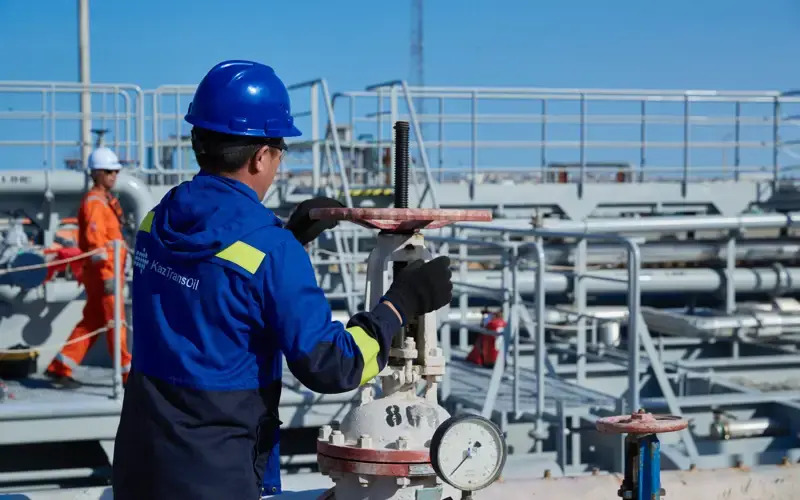
Photo credit: KazMunaiGaz
Energy Minister Yerlan Akkenzhenov said at an Aug. 25 government briefing that attacks on CPC facilities in January and again in July had resulted in nearly 3.5 million tonnes of lost oil production.
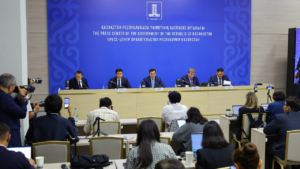
Energy Minister Yerlan Akkenzhenov said at an Aug. 25 government briefing that attacks on CPC facilities had resulted in nearly 3.5 million tonnes of lost oil production. Photo credit. PM’s press service
“We planned to produce 98 million tonnes, but the adjusted plan is now 96 million tonnes. The losses in production from the attacks on CPC will amount to 3.5 million tonnes,” Akkenzhenov said.
The minister said Kazakhstan and oil producers had also adjusted maintenance schedules to preserve as much production as possible in 2026. Tengizchevroil shareholders decided to postpone major maintenance until next year, while maintenance work at fields operated by North Caspian Operating Company was also moved to 2027. Maintenance at the Karachaganak field, meanwhile, is expected to begin in mid-September and is projected to reduce production by nearly 400,000-450,000 tonnes.
The developments highlight a broader challenge for Kazakhstan: as a major oil exporter, the country’s production capacity is only one part of the equation. Maintaining reliable access to international markets through secure and diversified export routes is equally important.
CPC remains critical to Kazakhstan’s oil exports
Kazakhstan produces substantially more oil than it consumes domestically, making export infrastructure a critical component of the country’s economic security. The CPC remains the country’s principal export route for crude oil, connecting Kazakhstan’s major producing fields with the Black Sea port of Novorossiysk.
Repeated disruptions have therefore created a challenge that goes beyond temporary reductions in pipeline throughput. They have raised questions about how quickly Kazakhstan can redirect crude if its main export route becomes unavailable or operates below capacity.
Economist and independent oil and gas reserves evaluator Abzal Narymbetov highlights that Kazakhstan’s position as a major net oil exporter makes diversification particularly important.
“Kazakhstan produces approximately five times more oil than it consumes domestically. This makes Kazakhstan a distinctly oil-exporting country,” Narymbetov wrote in his Energy Analytics Telegram channel.
He also said the strategic issue is not simply increasing production.
“The main question for Kazakhstan is not only how much oil to produce, but how to maintain export volumes, develop supply routes and increase added value within the country,” Narymbetov wrote.
According to him, in the longer term Kazakhstan should also focus on processing more crude domestically and developing petrochemicals and other higher-value products. This suggests that the current disruption could be viewed not only as an infrastructure problem, but also as a broader question of how Kazakhstan manages its dependence on oil exports.
Baku-Supsa emerges as an alternative
Akkenzhenov has identified the Baku-Supsa route as one potential alternative to CPC. Asked whether Kazakhstan had discussed transporting more crude through Azerbaijan, the minister said direct negotiations had not yet taken place, although preliminary groundwork existed.
“For this, first of all, we need to determine our position domestically in Kazakhstan. There is some groundwork from previous negotiations, but direct negotiations have not yet taken place,” Akkenzhenov said.
“Just imagine: we lost 3.5 million tonnes because of the attacks on CPC, although we could have redirected these volumes through the port of Aktau and the Baku-Supsa pipeline. Its capacity, by the way, is 5 million tonnes,” the minister added.
The minister’s comments point to a key limitation, however. An alternative route can provide strategic value even if it cannot replace CPC in terms of capacity. Baku-Supsa’s reported capacity of 5 million tonnes is substantially smaller than the volumes Kazakhstan exports through CPC. Its importance therefore lies less in replacing the main route and more in providing additional resilience when the main system is disrupted.
Diversification does not mean abandoning CPC
The current situation does not necessarily imply that Kazakhstan can or should move away from CPC. Instead, it highlights the economic value of having several export options. Political science expert Gaziz Abishev said that CPC remains an essential part of Kazakhstan’s economic security because the country invested in the project specifically to create an efficient route for its oil exports.
“CPC is an indispensable element of Kazakhstan’s economic security,” Abishev wrote on his Telegram channel, stressing that the pipeline was developed as an economic project rather than as a geopolitical instrument.
“Receiving oil revenues, Kazakhstan either accumulates them in the National Fund or spends them on social needs – in the interests of its people,” he wrote, adding that the country has maintained a neutral position while calling on all sides to pursue peace.
A test of Kazakhstan’s energy resilience
The latest production target adjustment shows how an external disruption to a major export corridor can translate into a measurable impact on Kazakhstan’s domestic production plans.
The loss of nearly 3.5 million tonnes and the reduction of the annual target to 96 million tonnes do not fundamentally change Kazakhstan’s position as a major oil producer. But they demonstrate the economic consequences of concentrated export infrastructure.
Akkenzhenov’s description of Baku-Supsa as “vital” suggests that the government is increasingly viewing alternative routes not simply as commercial opportunities, but as part of national energy resilience. At the same time, CPC will remain the backbone of Kazakhstan’s oil export system because of its scale and established infrastructure.
The challenge is that alternative routes have different capacities, infrastructure requirements and costs. Moving additional volumes through the Caspian requires sufficient port capacity, tanker availability and infrastructure on the other side of the sea. That means diversification is not simply a matter of signing agreements. It requires sustained investment in the entire logistics chain.
