
ASTANA – Kazakhstan is becoming increasingly important to Washington not only as a source of energy and critical minerals, but also as a key partner in developing alternative trade routes and strengthening U.S. engagement across Central Asia. A meeting between President Kassym-Jomart Tokayev and a delegation of the U.S. House of Representatives on Aug. 25 highlighted the expanding scope of that relationship, as both sides emphasized economic cooperation ahead of Tokayev’s planned participation in the G20 summit in Miami.
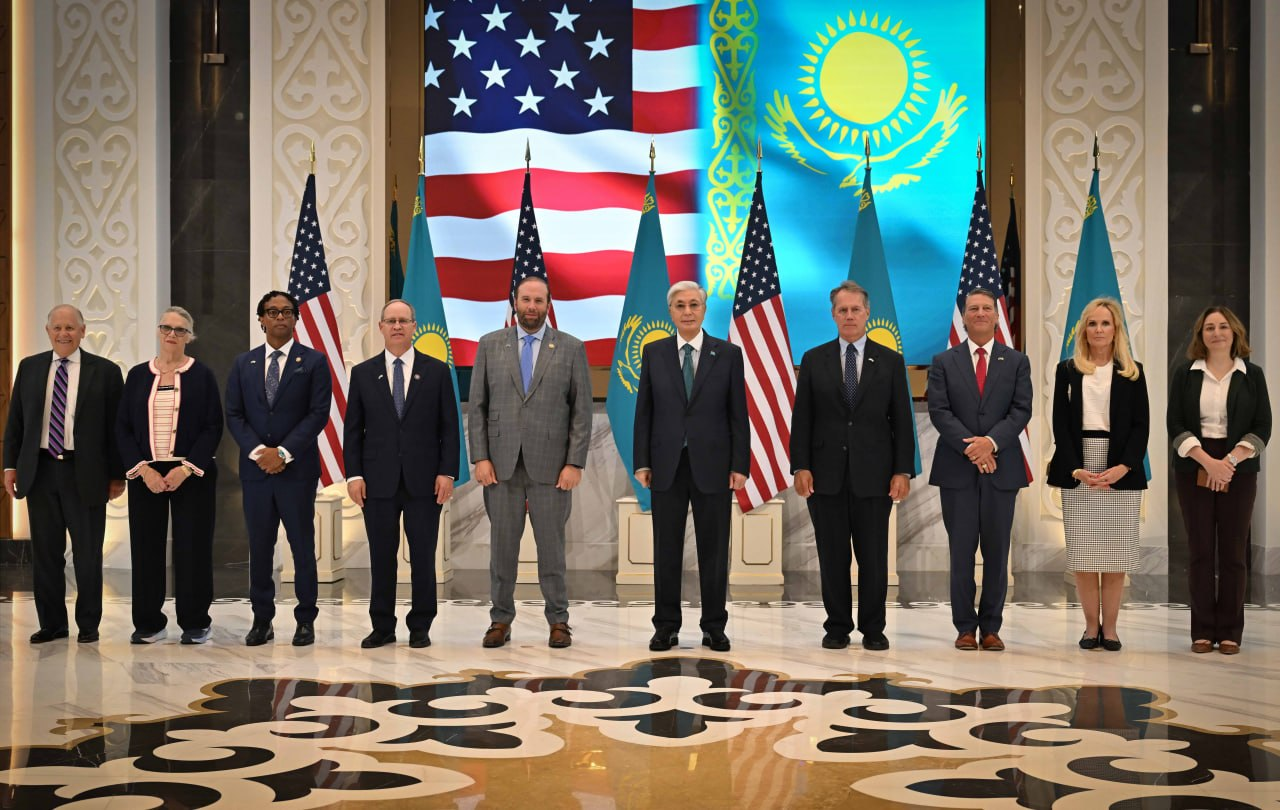
President Kassym-Jomart Tokayev met with a delegation of the U.S. House of Representatives on Aug. 25 in Astana. Photo credit: Akorda.
The delegation was led by Jason Smith, chairman of the U.S. House Committee on the Budget and Taxation, and included Congress members Greg Murphy, Carol Miller, Ronny Jackson, Wesley Bell and Edward Case.
Tokayev highlighted the timing of the delegation’s visit, which came shortly after Kazakhstan’s first elections to the new unicameral Kurultai. According to him, parliamentary diplomacy would become an important area of activity for the new legislature.
“Constructive and meaningful dialogue between members of the U.S. Congress and the Kurultai is important for further deepening mutual understanding, promoting common priorities and strengthening the Kazakhstan-U.S. partnership,” Tokayev said.
The meeting also comes ahead of Tokayev’s planned visit to Miami for the G20 summit, following an invitation from U.S. President Donald Trump.
From political dialogue to economic interests
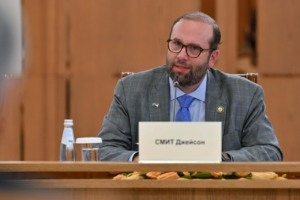
Jason Smith, chairman of the U.S. House Committee on the Budget and Taxation. Photo credit: Akorda.
The discussion reflects a broader expansion of the Kazakhstan-U.S. relationship, which increasingly extends beyond traditional diplomatic cooperation. Tokayev briefed the delegation on Kazakhstan’s political and socioeconomic reforms and outlined the country’s modernization priorities.
Smith emphasized the economic dimension of the delegation’s visit. According to him, Trump asked to convey his warmest greetings and expressed his appreciation for the trusting and constructive relationship that has developed between both leaders.
“He also said that he looks forward to your visit to Miami to participate in the G20 summit,” Smith said.
“One of the main goals of our visit is to explore opportunities for further expanding economic ties between the U.S. and your wonderful country. We are firmly committed to meaningful dialogue on strengthening bilateral cooperation,” Smith added.
This emphasis is significant because the relationship is increasingly being driven by practical economic interests rather than diplomacy alone.
Kazakhstan’s strategic position
The growing U.S. interest in Kazakhstan also reflects the country’s position within a rapidly changing Eurasian environment. A discussion held Aug. 21 by the CFive Intellectual Platform and the Hudson Institute brought together experts from the U.S., Kazakhstan and Switzerland to examine the changing dynamics across Eurasia.
The discussion highlighted different interpretations of Kazakhstan’s emerging role. Ken Moriyasu, senior fellow at the Hudson Institute and an expert on Greater Asia, Central Asia and the Caucasus, described Kazakhstan as the “most important swing state in the world.”
His argument places Kazakhstan within the broader competition between the U.S. and China. He said Central Asia, the Caucasus and Türkiye could become increasingly important in that competition.
His framing, however, raises a broader question: should Kazakhstan’s importance primarily be understood through the competition between larger powers?
The growing U.S. engagement therefore does not necessarily indicate a shift away from a balanced foreign policy. Instead, it could strengthen Kazakhstan’s ability to maintain a diversified network of international partnerships.
The G20 invitation
Tokayev’s upcoming participation in the G20 summit in Miami provides a particularly visible example of this expanding engagement. The latest invitation is significant because it comes from Washington at a time when the U.S. is showing greater interest in Central Asia and the wider Trans-Caspian region.
Iskander Akylbayev, CEO of Xander Group and chairman of CFive, described the upcoming summit as a practical opportunity for Kazakhstan.
“My expectation is that the Miami G20 will be highly pragmatic and transaction-driven,” he said, identifying economic growth, secure energy supply chains and technological innovation as likely priorities.
The invitations extended to Uzbekistan and Azerbaijan can be also an evidence that Washington’s engagement extends beyond Kazakhstan. Thus, Kazakhstan’s growing importance to the U.S. can be viewed both as recognition of its individual economic and strategic weight and as part of a broader American effort to strengthen ties across the Trans-Caspian region.
A partnership with room for expansion
During the Aug. 25 meeting, Tokayev also emphasized cooperation between Kazakhstan and the U.S. in multilateral formats, including efforts to promote global and regional stability. He highlighted Kazakhstan’s support for U.S. initiatives, including the Board of Peace and the Abraham Accords, as well as cooperation on nuclear security and non-proliferation.
Smith, for his part, said Trump had expressed appreciation for the relationship and looked forward to Tokayev’s participation in the G20 summit. The upcoming meeting in Miami could therefore provide an opportunity to translate the growing political relationship into concrete economic agreements.
But the long-term significance of the partnership will depend on whether increased diplomatic attention results in sustained investment, technology cooperation, expanded trade and infrastructure development.
The latest meeting in Astana, the upcoming G20 summit and the expanding focus on economic cooperation suggest that Kazakhstan-U.S. relations are entering a more pragmatic phase – one in which the strength of the partnership will increasingly be measured by concrete economic outcomes rather than diplomatic rhetoric alone.
