
ALMATY – For generations of Almaty residents, fountains have marked the rhythm of summer. They are meeting places, playgrounds, works of art and fragments of history hidden among the city’s trees.
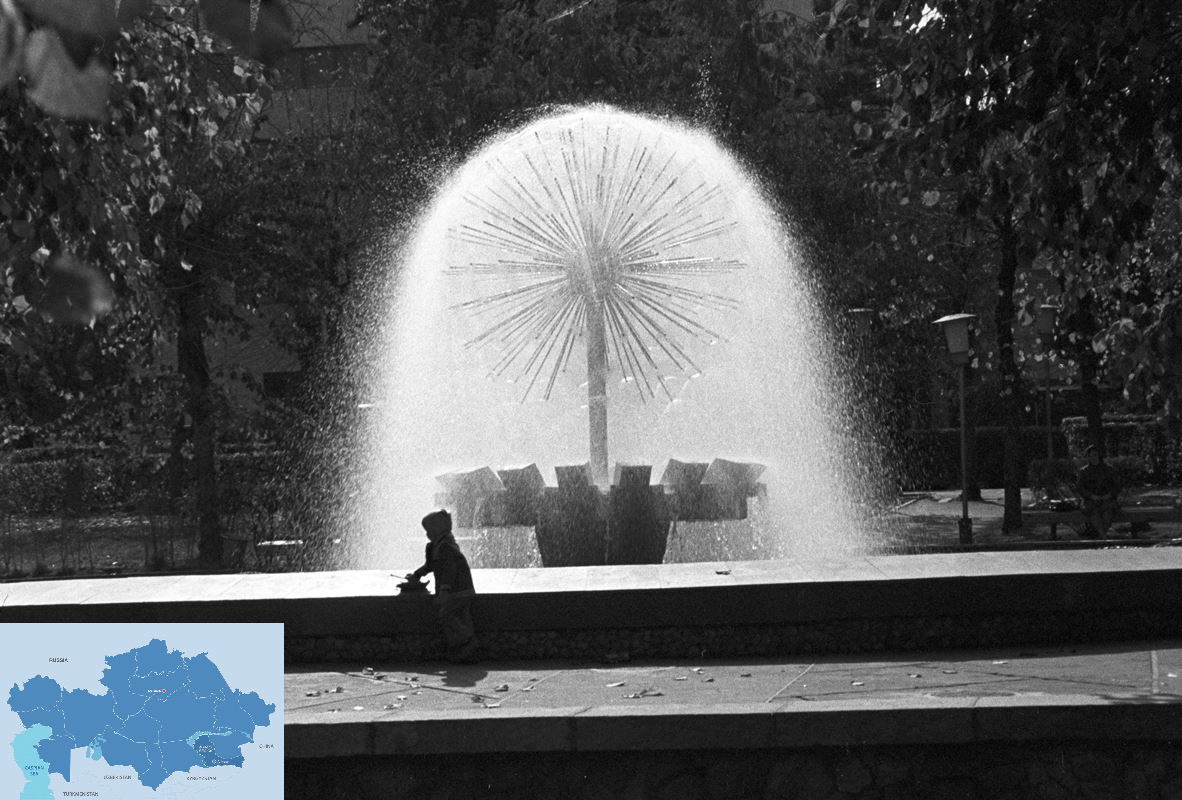
Dandelion Fountain, completed in 1978 outside today’s Kazakh National Academy of Arts. Photo credit: The Central State Archive of Film and Sound Recordings. Click to see the map in full size. The map is designed by The Astana Times.
Today, Almaty operates more than 120 fountains and fountain complexes, making it the undisputed fountain capital of Kazakhstan. Sixty-three belong to the municipality, while the remainder are privately owned. Unlike many cities where fountains exist primarily for decoration, in Almaty they were conceived as part of the city’s environmental infrastructure.
Nestled against the northern slopes of the Zailiysky Alatau mountains, the city experiences long, hot and relatively dry summers. The fountains, together with the famous network of mountain-fed irrigation canals known as “aryks,” were designed to cool streets, humidify the air and make public spaces more comfortable long before air conditioning became commonplace.
Before Almaty became a megapolis
For decades, guidebooks confidently stated that the city’s first fountain appeared in 1948, when ornamental fountains were constructed near the Abai Opera and Ballet Theatre. Local historian Alois Nazarov, however, challenged this widely repeated claim.
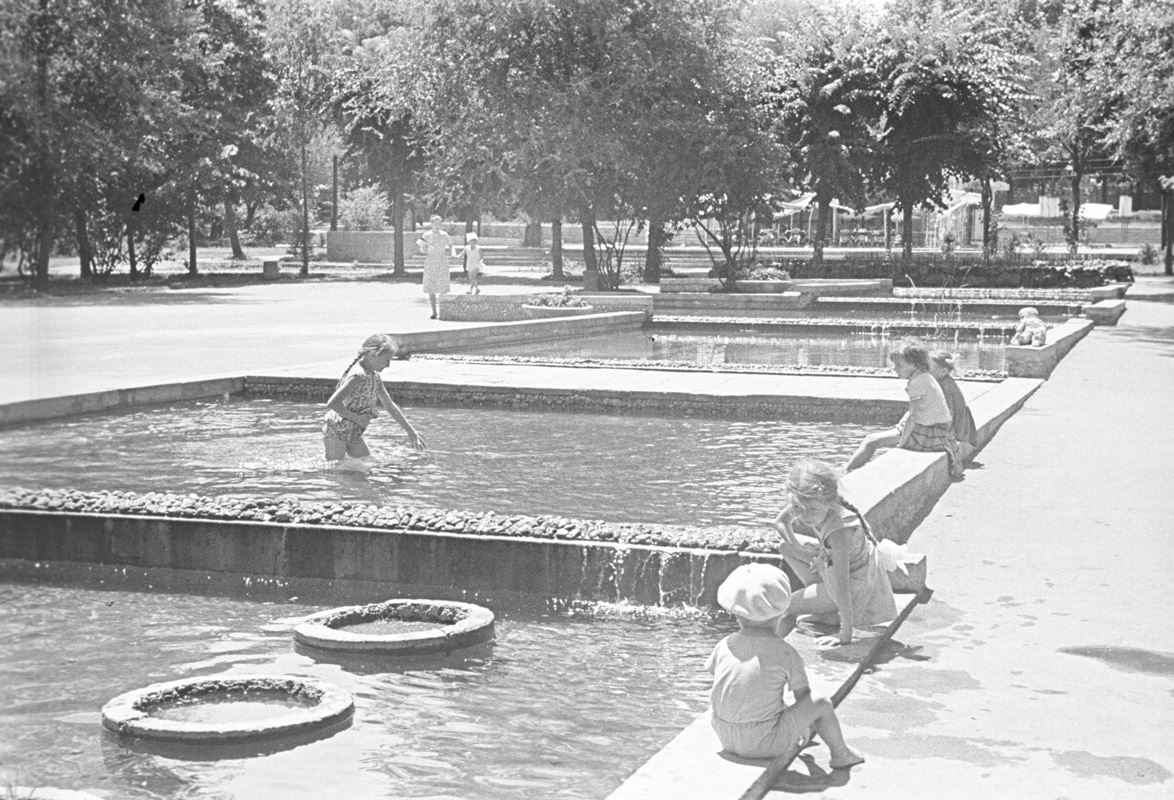
A cascade of pools in the square near the Abai State Academic Opera and Ballet Theatre. 1964. Photo credit: The Central State Archive of Film and Sound Recordings.
According to Nazarov, the 1948 date referred only to the first fountains constructed from durable materials – not the first fountains themselves. The earliest documented fountain connected with the region dates back even further.
According to the archival documents, in 1878, physician, botanist and explorer Albert Regel visited the summer residence of Semirechye Military Governor Gerasim Kolpakovsky near the mouth of the Butakovka River. His travel notes describe a landscaped estate complete with a pond and two fountains. Although these stood outside the city of Verny (now Almaty) and cannot truly be considered urban fountains, they remain the earliest recorded examples in the area.
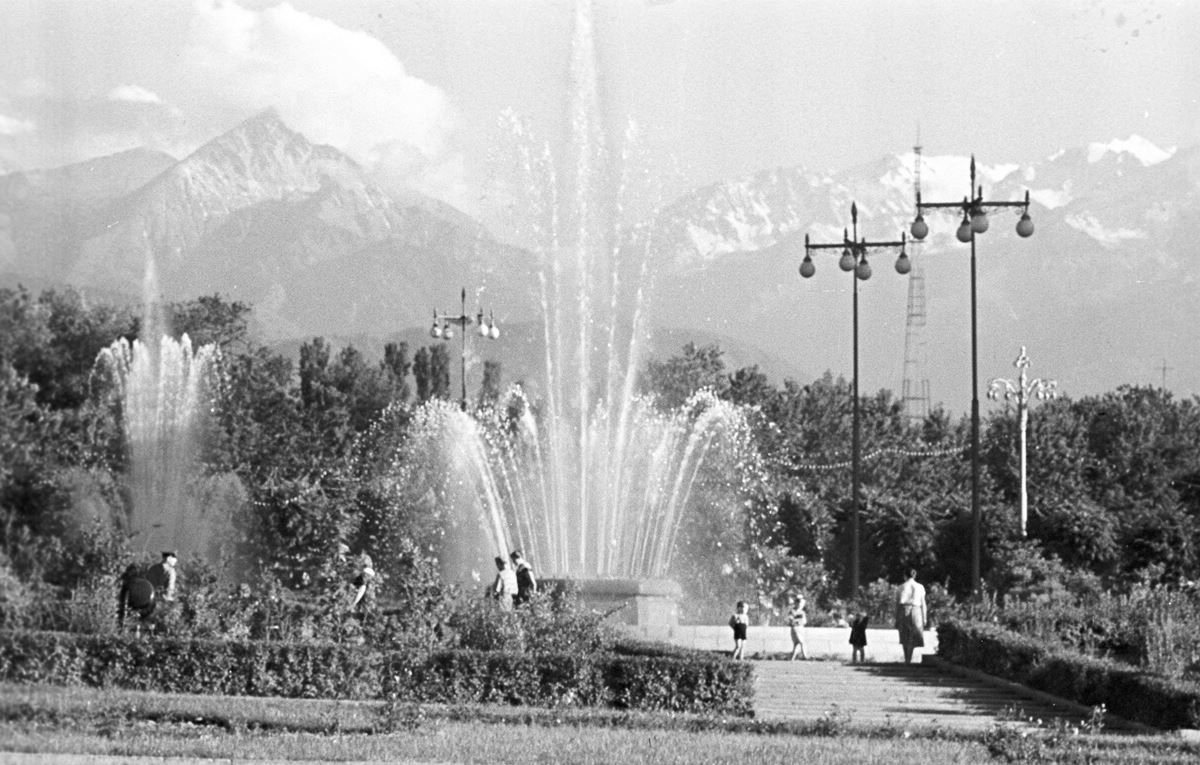
Fountain on Lenin Square, now Republic Square. 1961. Photo credit: The Central State Archive of Film and Sound Recordings.
One curious reminder survives in the city’s old street names. Present-day Tulebayev Street was briefly known as Fontannaya (Fountain Street) in the early twentieth century. The name had nothing to do with decorative fountains; instead, it referred to one of the city’s first wooden water pipelines, completed in 1901. Along the pipeline stood public water basins and columns where water gushed with enough force that residents likened them to fountains. True ornamental fountains would arrive only after the city assumed a new role.
Building a socialist capital
Everything changed when the capital of the Kazakh Autonomous Socialist Soviet Republic (ASSR) moved from Kyzylorda to Alma-Ata in 1929. The city suddenly found itself at the center of an ambitious urban transformation.
Government buildings, theaters, schools and apartment blocks rose rapidly across the expanding capital. Architecture embraced the functional aesthetics of Soviet constructivism, but planners also wanted the new socialist city to appear welcoming and modern.
Fountains became one of the easiest ways to soften the austere geometry of new public spaces. A historical newspaper, Socialist Almaty, from the late 1930s reveals a surprisingly vibrant fountain culture.
In the former Dzerzhinsky Children’s Park, visitors were greeted by sculptural storks pouring water from their beaks into ornamental pools. Further inside stood a fountain featuring two young pioneers, while another displayed playful dolphins.
Panfilov Park featured its own artistic compositions. One fountain depicted a mother with two children near what is now the Ascension Cathedral, while another, nicknamed “The Mushroom,” allowed visitors to sit beneath a concrete canopy before suddenly surrounding them with a curtain of water, creating what newspapers described as a refreshing summer pavilion.
Fountains also appeared in front of hospitals, cafés, factories and schools. By the end of the decade, they had become almost mandatory components of new construction.
A city discovers water
Fountains flourished in a city that constantly struggled with water shortages. Before the mid-twentieth century, Alma-Ata relied primarily on mountain streams and irrigation canals for its water supply.
The breakthrough came thanks to renowned Kazakh hydrogeologist Ufa Akhmedsafin, who identified vast underground freshwater reserves beneath the city during the 1940s. For the first time, the city possessed enough water not only for industry and households but also for ambitious landscaping projects. The expansion of the municipal water system allowed fountains to multiply across parks, boulevards and public squares.
The golden age of fountains
The real boom arrived during the 1960s and 1970s. Under Dinmukhamed Kunaev, who personally oversaw much of Alma-Ata’s development, fountains became symbols of the city’s identity. Several of today’s best-known landmarks date from this period.
Architect Mels Safin created the celebrated Zhetysu Fountain at Abai Avenue and Tulebayev Street in 1970. Seven springs cascade through granite basins, symbolizing the historic Seven Rivers region, while traditional Kazakh ornament decorates the central stele.
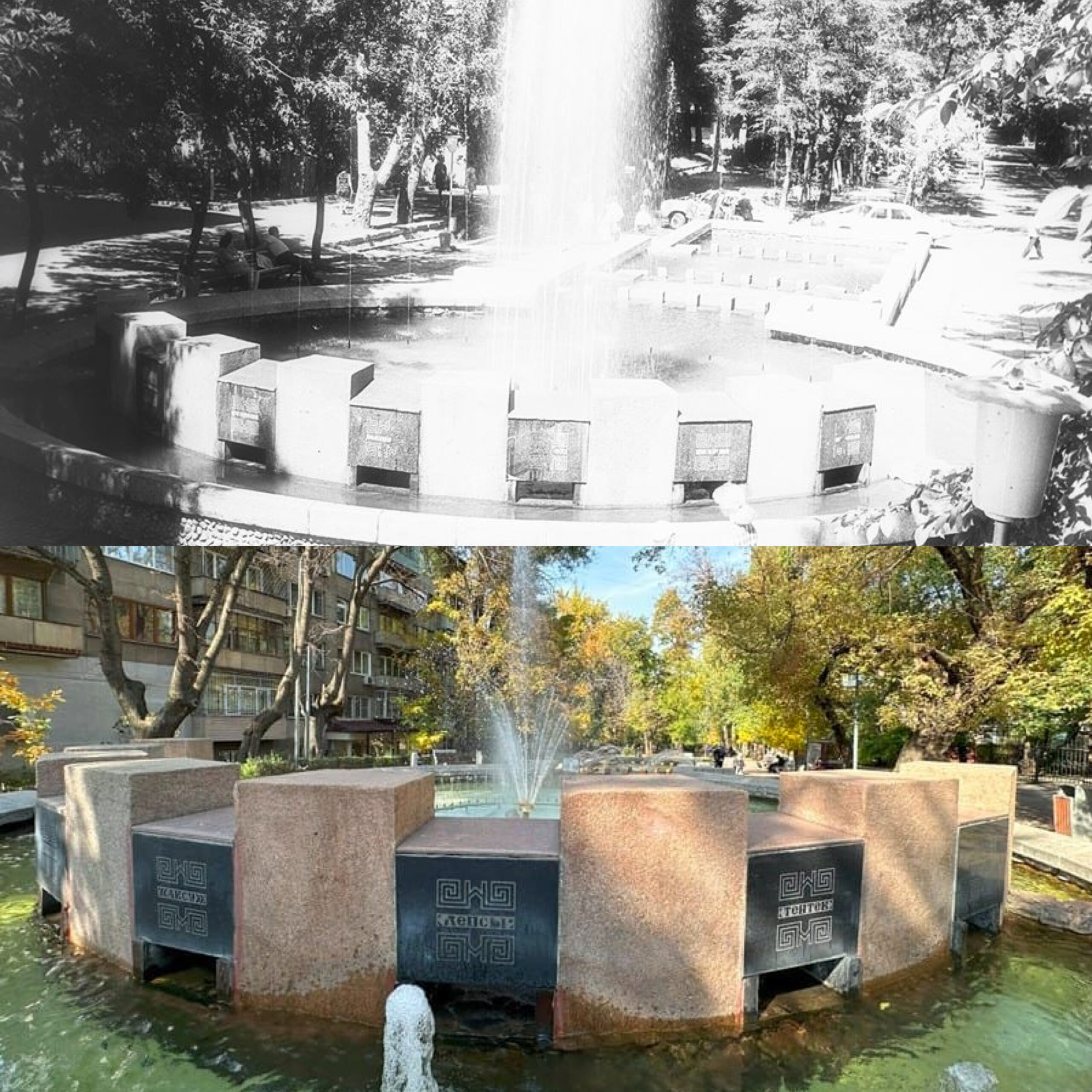
(T) The Zhetysu Fountain. July 26, 1974. Photo credit: The Central State Archive of Film and Sound Recordings. (B) The Zhetysu Fountain now. Photo credit: Alexander Petrov.
Safin also designed the beloved Dandelion Fountain, completed in 1978 outside today’s Kazakh National Academy of Arts. Using 168 precisely positioned nozzles, it creates an almost perfect sphere of water that shimmers like the head of a giant dandelion. The fountain has been under renovation since 2023 and reopened recently. The landmark’s appearance has remained the same, but there is now a light display.
Nearby stands another favorite Almaty fountain – Nedelka (Week). Originally envisioned with twelve arches representing the months of the year, the available space accommodated only seven. Rather than abandoning the concept, the designers embraced the new number, transforming the installation into a symbol of the seven days of the week. Its cascading streams evoke a rushing mountain river, especially when illuminated after sunset.
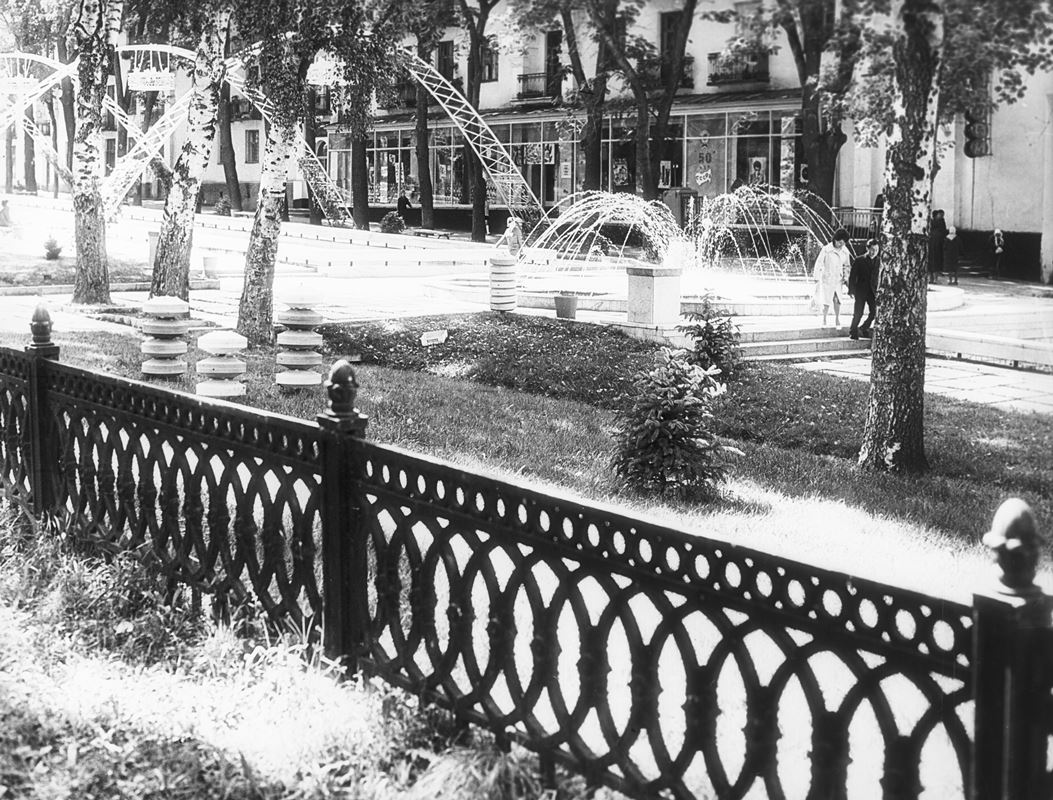
The Nedelka fountain on Bayseitova Street. June 28, 1976. Photo credit: The Central State Archive of Film and Sound Recordings.
Perhaps the city’s most artistic fountain is the Oriental Calendar, unveiled in 1979 opposite the National Academy of Sciences. Bronze sculptures representing the twelve animals of the Turkic zodiac surround the basin, transforming an ordinary fountain into an open-air sculpture garden. The project later received recognition from the Union of Artists of the USSR as one of the finest examples of decorative park sculpture of its era.
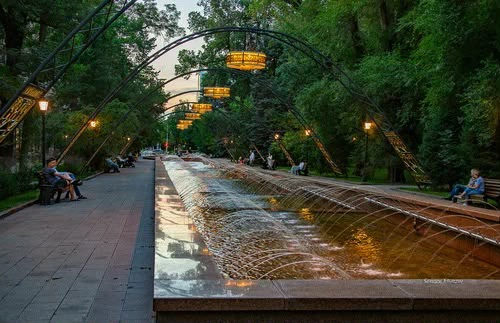
The Nedelka fountain now. Photo credit: Sergey Murzin.
Meanwhile, fountains appeared beside the Hotel Kazakhstan, the Kazakh Circus, the Russian Drama Theatre, and countless neighborhood parks. Historian Nazarov once described them in his notes as “not roaring dragons, but quiet companions,” places where office workers escaped the summer heat and young couples lingered long after sunset.
Forgotten survivors
Not every fountain survived the city’s rapid modernization. Some disappeared beneath new construction. Others simply fell silent as pipes rusted and infrastructure aged. Yet hidden corners of Almaty still preserve rare examples of the earliest generation.
A neglected fountain remains tucked away inside the courtyard of the Kazakh National Academy of Arts, once the site of the Government House. Another stands near the former National Museum of Books on Kunaev Street.
Though long dry, historians consider them among the oldest surviving fountains in the city and argue they deserve restoration as important examples of early Soviet landscape architecture. Today, fountains remain inseparable from Almaty’s identity. Perhaps that explains why Almaty continues adding new ones.
