
ASTANA — For President Kassym-Jomart Tokayev, geography is becoming one of Kazakhstan’s greatest strategic advantages. Speaking at the XXII Kazakhstan-Russia Interregional Cooperation Forum on July 25 in Omsk, he said that the world’s longest continuous land border shared by Kazakhstan and Russia positions the two countries to play a leading role in shaping Eurasia’s transport and logistics architecture.
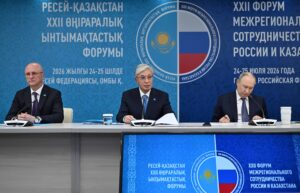
Photo credit: Akorda.
“Kazakhstan and Russia, sharing the world’s longest continuous land border, are destined to play a leading role in developing the transport and logistics architecture of the Eurasian continent. This is a key factor in our countries’ global competitiveness in today’s highly complex geopolitical environment,” Tokayev said.
That idea framed much of Tokayev’s address at the forum. While transport corridors remained at the center of discussions, he presented logistics as a broader ecosystem that is intertwined with industrial cooperation, digital technologies, air connectivity and cross-border mobility to strengthen regional integration.
For Marat Ramazanov, head of the Department of European and American Studies at the Kazakhstan Institute for Strategic Studies (KazISS), Tokayev’s emphasis on logistics reflects broader changes, such as bilateral cooperation, rather than simply growing transit volumes.
“The forum’s theme reflects qualitative changes taking place in the global economy. Today, countries’ competitiveness is determined not only by production capacity but also by their ability to integrate effectively into international value chains,” Ramazanov said.
He said this year’s focus on a global logistics ecosystem reflects broader changes in the world economy, where competitiveness increasingly depends on countries’ ability to integrate into international value chains. In that context, Kazakhstan and Russia are moving beyond individual transport projects toward a more integrated model combining transport infrastructure, digital platforms, industrial cooperation, customs procedures and investment mechanisms.
Kazakhstan and Russia’s geographic position gives them objective advantages in this environment. Rather than focusing on individual transport projects, the two countries are increasingly building what Ramazanov describes as a “single logistics ecosystem” that integrates transport infrastructure, digital platforms, industrial cooperation, customs procedures and investment mechanisms.
Building a seamless logistics ecosystem
President Tokayev outlined several priorities that, in his view, could further strengthen Kazakhstan and Russia’s role as Eurasian transit hubs. Among them, he highlighted the continued development of the North-South International Transport Corridor, which links Russia with Central Asia and South Asia through Kazakhstan, as well as the Western Europe-Western China transport corridor. He also called for expanding railway capacity, modernizing border infrastructure and increasing freight volumes across existing routes.
One of the initiatives he proposed was the creation of a Kazakhstan-Russia Digital Transport Corridor to simplify cross-border freight movement through the wider use of electronic documentation and intelligent transport systems.
“I am confident that the effective digital integration of our transport and logistics systems, together with the broader use of new technologies, will enable us to increase bilateral trade, expand transit flows and comprehensively strengthen our economic ties,” he said.
Tokayev also highlighted the first run of unmanned freight vehicles between the two countries, describing it as evidence that Kazakhstan-Russia transport cooperation is moving to a new technological level.
“Together, we are addressing all the tasks in this area, consistently developing infrastructure and strengthening our transit potential,” he added, noting that rail freight between Kazakhstan and Russia reached 92 million tons last year, while container traffic along the China-Kazakhstan-Russia route has increased eightfold over the past five years. Road freight has also accelerated, more than doubling in the first quarter of 2026 compared to the same period a year earlier.
While infrastructure remains the backbone of bilateral cooperation, experts say its long-term success will increasingly depend on how effectively both countries integrate digital technologies into transport and industrial projects.
According to Manarbek Kabaziyev, deputy chairman of the Foreign Policy Research Institute under Kazakhstan’s Foreign Ministry, the next stage of cooperation is less about building new routes than making existing ones work better.
“Artificial intelligence does not replace traditional areas of cooperation — it strengthens them,” Kabaziyev said. He said that AI can improve freight forecasting, optimize logistics chains, support predictive maintenance of transport infrastructure and industrial equipment, and automate production processes.
Kabaziyev also pointed to the growing importance of modernizing railway crossings, expanding the capacity of border checkpoints, digitalizing customs procedures and creating seamless logistics services. Combined with deeper industrial cooperation, he said, these measures could significantly improve the competitiveness of Eurasian transport corridors.
Tokayev also proposed launching a joint “500+” aviation initiative to expand direct air links between the two countries. According to him, increasing connectivity would support not only business activity but also tourism, with Russia remaining Kazakhstan’s largest source of leisure visitors.
Tourism was also another area with untapped potential that was highlighted by Tokayev. He called for the development of joint cross-border tourist routes and closer cooperation between tourism industries. Russia remains Kazakhstan’s largest source of leisure tourists, followed by China, India and Türkiye, he noted, adding that Kazakhstan’s geographic location, diverse landscapes and rich cultural heritage create favorable conditions for further growth.
“The development of cross-border tourism is not only about the economy. It is an investment in strengthening mutual trust and building a shared neighborhood space,” Tokayev said, describing tourism as “a powerful driver of joint development.”
Unlocking economic potential
Beyond transport and logistics, Tokayev emphasized that practical cooperation between Kazakhstan’s and Russia’s regions continues to strengthen bilateral ties by translating political agreements into concrete initiatives.
“The strength of Kazakhstan-Russia relations lies in the fact that the trusting dialogue at the highest level is reinforced by active contacts among regions, businesses, the scientific and cultural communities, and, most importantly, by the friendship of millions of people,” he said.
That political foundation continues to be reinforced by expanding economic ties. Bilateral trade approached $28 billion last year and grew by nearly 10% in the first five months of 2026 compared to the same period a year earlier. Kazakh president also highlighted a portfolio of 177 major industrial projects worth more than $52 billion, with 122 already completed, creating more than 30,000 jobs. He described Kazakhstan’s first nuclear power plant, to be built by an international consortium led by Rosatom, as a project of “truly strategic” importance for bilateral cooperation.
“The forum has become an independent mechanism for implementing the strategic partnership,” Ramazanov from KazISS said, noting that it has evolved far beyond its original role as a platform for border regions by bringing together governments, businesses and research institutions to translate political agreements into concrete economic projects.
The experts’ assessments reinforce the central message of Tokayev’s address. Rather than redefining Kazakhstan-Russia cooperation around a single sector, this year’s forum pointed to a more integrated model in which transport infrastructure, industrial partnerships, digital technologies and regional cooperation reinforce one another. Geography may provide the foundation, but, as the discussions in Omsk suggested, long-term competitiveness will depend on how effectively that foundation is developed.
